
What Is BPC-157, and How Can It Help Rid My Pain?
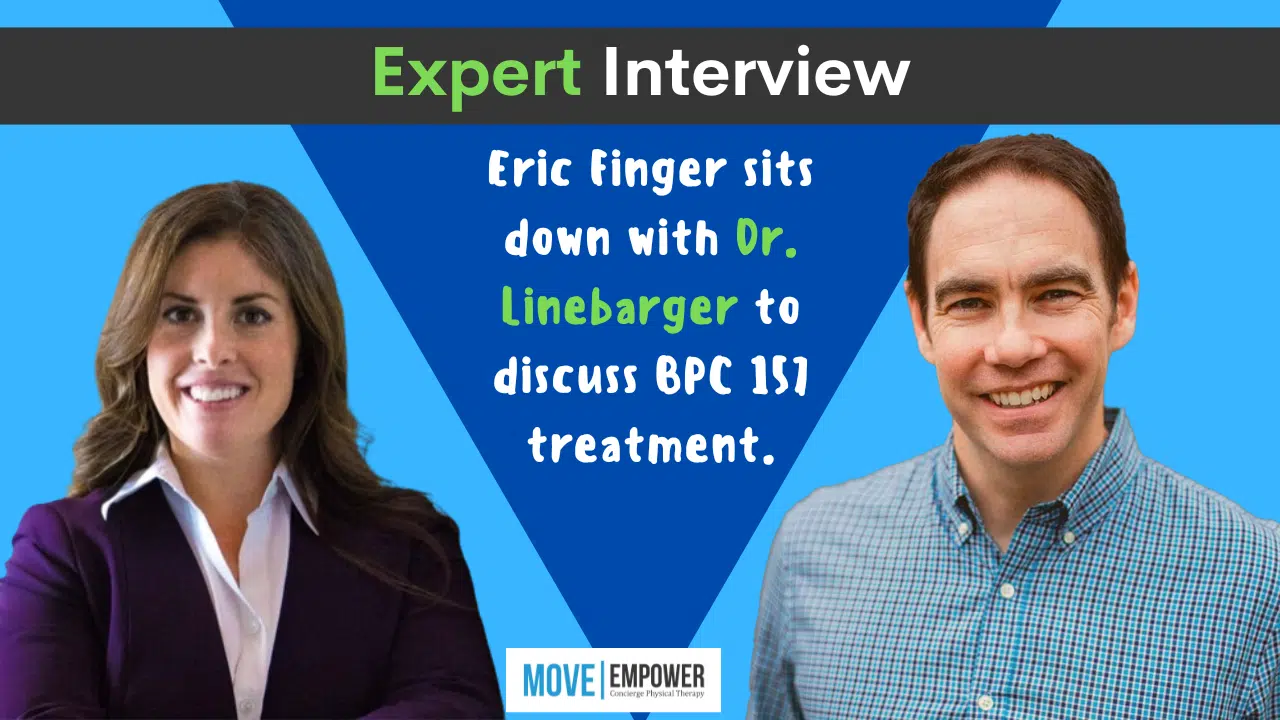
Today, we have something extra special for you! Eric sat down with Dr. Linebarger from 360 MD Austin to discuss a new medical treatment that she is using that shows lots of promise. Watch the full interview in the video below, or read the full transcript at the bottom of the page.
What I’m excited to talk about today is a treatment that she has been using with her patients called BPC 157. And excited to have her here today to kind of talk about that, what she’s using it for, and some of the kind of exciting results that she’s seen and that I’ve seen, you know, after working with some of her clients and such. So without any further ado, Dr. Linebarger, welcome and thanks for being here this morning.
Dr. Linebarger: Great. Thank you!
Eric: Love that! Love that! That’s one of the challenges I’ve gotten to in my career. I’ve got to do is to work with folks who hadn’t had, you know, exercise or wellness in there. Kind of one of their top priorities. And it is pretty rewarding to get those folks to transition and see the value in it. Anyways, I love it. Thanks for the intro on that. Well, let’s go into the topic of today, which is that BPC 157. I mean, it sounds like a battleship or something, but what is this BPC 157? And so kind of tell us a little bit about it, and then how you got introduced to it and such.
Dr. Linebarger: I don’t know exactly how long it’s been around, but I know that there’s been studies on it for healing and recovery from injury for over 25 years. It’s called body protective compound. It is a natural compound that is found in gastric juices. That is what we know about it. The kind that we take is a synthetic version. So we do take a synthetic version of that. That comes from that. From the peptide that is found in gastric juices. It is used different ways, mostly for reflux and gastric reflux, and then for injury recovery. It does three things that I know of. It promotes angiogenesis, which is increased blood flow. It promotes granulation tissue, which is when you have healing. One of the steps of healing is to form what’s called granulation tissue, and then it also forms collagen. So those are the three mechanisms that I’m aware of, at least, that BPC 157 does love it.
Eric: And all very fundamental for healing and probably expediting the healing. So that’s. That’s pretty cool. So it almost sounds like it’s a. It kind of accelerates the healing process or kind of gives it a jump.
Dr. Linebarger: Start, is that it seems to. And you need blood flow for healing. Right? So that’s why a lot of times, we’ll talk about. People ask a lot about using ice versus heat and stuff like that. And there, there, as you know, there are reasons to do both. But when we want healing, specifically when you want to reduce inflammation a lot, we will use more ice. But when you healing needs blood flow, so that’s how you bring the growth factors that will help heal. So that’s why doing things like BPC 157, that increases blood flow will speed up recovery.
Eric: Yeah, no, that makes total sense. And that’s definitely something that I preach as well to my folks and such, and kind of knowing when to, you know, ice and heat do have their place, but kind of knowing when in that healing process to use it. Yeah, I love that. I think the other important part that you were just talking about with the blood flow is that blood flow has oxygen. That’s probably one of our best parts of healing, is getting the oxygen to the tissues to kind of start that chain of events for healing. So that totally makes sense on how that increased blood flow would help with those injuries. Perfect! So I’m curious then. So this has been in your practice for, I don’t know, how long has it been in your practice and what have you started kind of using it for? I’m just curious on what injuries that you’ve used it for.
Dr. Linebarger: I’ve always been interested in musculoskeletal injuries. I was a college athlete. I was a yoga teacher, trainer. I was crossfit instructor. And I would say fitness is probably my biggest hobby outside of medicine. So when I started doing this concierge model and getting interested in longevity, I started doing training courses in longevity medicine.
And then I was doing, I think, HRT. I’m pretty sure it was through doing hormone replacement that I came across peptides. It was just kind of in the same world and. And the same training and the same conferences that a lot of longevity people go to. And then I learned about peptide. So I did two different peptide training courses, and BPC 157 is one of the most commonly prescribed.
So then I isolated a few people that I thought could benefit from it. I initially started using it in capsule form for people who had reflux and were taking loss of Nexium and other PPIs. And I was trying to get them off of that. And I had great success. I got people off of their PPIs and Zantac just by doing a three month course at BPC 157.
Then I started doing it in the subcutaneous injectable form. And I have a really good story that I can share. I started using it on myself. There’s so much to talk about with that. But one of the first people I used it on, he is a semi-professional water skier. He’s in his fifties, and he had torn his groin muscle and adductor muscle, and it took a year of recovery before. And this was confirmed on MRI. He saw orthopedics and he did intense rehab, and he fixed it. And he was back on the water about a year later. And he was my patient at that time.
About a year later, he did it again on the other side, same muscle. And I had done my training. And I said, I think he might have been one of the first that I tried it on. I said, why don’t you try injecting this? And you inject it every day for about three, a month to two, one to two months, every single day. Subcutaneous. So a tiny little needle, and it needs to be near the site of injection, not right on the site of injection, because that where the, I mean, site of injury, not injection.
And so it needs to be near the site of injury. You inject it near the site of injury every single day for one to two months. And he did that. And his orthopedic doctor could not believe that it had healed in two months. It had completely healed. And he said he’d never seen anything like that. And I was pretty convinced on this peptide after that.
Eric: That’s amazing. That’s amazing stuff. How do you educate, I mean, you obviously do this silly question, but I’m curious for folks out there curious about this, so you show them, hey, this is where I suggest you do the injection. And they do kind of do that area on every dose, is that right? Kind of the same region?
Dr. Linebarger: And the maximum dose that is safe is extremely high. So compared to the amount that we usually recommend. And so when patients have multiple sites of injury. I have a guy now, he has a diagnosis of rheumatoid arthritis, and he is using it in several areas. He just has inflammation in his elbows and his knees and his shoulder. So he’s been using it pretty frequently and has had very significant results. Sometimes it’s easier to do by yourself than other times. I mean, if you have a neck injury, it’s kind of hard, just logistically to do, but when it’s your knee or in my case, I used it myself on a hamstring tear that I had, and they’re pretty easy to do on my own.
Eric: That’s amazing. That’s — I love that story, though, on the, on the water skewer, because those inner thigh groin adductor injuries can be really tough, really tough to recover from that. That’s pretty darn amazing. A little anecdotal story on my end, I was at a dinner just a couple months back and I had, ironically, had just learned about this peptide, I think, through you and through a conversation we had had. And literally that weekend I sat down with a dinner with, and it was actually with a couple physicians. Gentleman was in his mid-fifties, had just had a rotator cuff repair.
During our conversation he asked if I was familiar with BPC-157. He goes on to discus how he used post operatively with a shoulder surgery. He goes on to explain how after beginning use of the drug how quickly his shoulder pain, range of motion, and strength returned. Both the patient and his surgeon were shocked on how quickly , his range of motion, strength were back
Yeah. So there’s something to this. Now, granted anecdotal stories, but definitely very interesting. It’s very safe. You know, there was no risk of infection or anything like that, even though he was a just a few weeks from his shoulder surgery. It was amazing to see how quickly he regained his strength after a shoulder surgery that usually takes up to a year to fully heal. He was back to lifting in the gym in 5-6 months after rotator cuff surgery. So very cool to hear that story and then to kind of back it up with what I’ve heard these days. So exciting stuff.
So very cool to hear that story and then to kind of back it up with what I’ve heard these days. So exciting stuff. Very good! So we’ve talked about kind of what injuries you’ve treated and such. We’ve talked about the dosing and such. Are there any, you know, any folks who this isn’t good for, you know, or as we say in the trade, contraindications are there, you know, what’s the safety on it and such or, you know.
Dr. Linebarger: It has a very — it’s very safe. The safety profile is definitely very high. I have had zero side effects. So I tell patients it either works or it doesn’t. And the one patient that I had that it didn’t work on, he had confirmed osteoarthritis in his neck. He had no side effects from doing it, but it didn’t work. So it’s not, it doesn’t work well for people who have irreversible injuries.
Eric: Sure, sure.
Dr. Linebarger: It works for people who have inflammation. They have an injury secondary to inflammation or something like that. So that’s who, it works really well for there are some thoughts of the contraindications of people with potential malignancy. Because you’re promoting angiogenesis, you’re increasing blood flow and growth.
Eric: That makes sense. I could understand that. You don’t want to see cancer.
Dr. Linebarger: You don’t want to see cancer. But I find in my anecdote, as you will, is it has been extremely safe. So there are certain other peptides that I would not use and people who I would be nervous that could have an underlying cancer. But BPC 157 seems really safe. It’s pretty locally acting, and I would use it on just about anybody.
Eric: Cool, cool. So it sounds like going back to that example you said where maybe didn’t work was the degenerative arthritis. Maybe not so much. But for sprains, strains, those kind of acute injuries, or like your gentleman, they adopt her. That would sound like a moderate strain. Those are kind of the folks who you’re like, oof, this could work really well for.
Dr. Linebarger: Mm hmm. Yeah, definitely.
Eric: Awesome! Very cool! Wonderful! We talked about some of the outcomes and such. What’s the, you know, what’s…. How much does something like this cost? Is this, you know, what’s, what’s this like for — for folks? I… Yeah, tell us about that.
Dr. Linebarger: Well, I am aware of some clinics in town that charge a lot for it. They’ll charge $20, $30 for a one time shot, which not make sense for most people because you, to be effective, it is not dosed one time. It needs to be dosed daily. So it — You should find a place that gets it from a reputable, FDA approved pharmacy, because they. It is not an FDA approved medication, but it is made in pharmacies that are FDA approved and regulated.
Eric: Okay.
Dr. Linebarger: And we charge about 250 — $250 for a bottle, and that bottle will last 30 to 60 days.
Eric: Okay.
Dr. Linebarger: So I think that I would say patients, wherever they go, should not pay any more than $400 for a bottle of it to last 30 to 60 days.
Eric: Gotcha. Okay. Okay. But I think the most, one of the biggest things you said there was making sure it’s FDA approved and such. And for folks to do that, is that a simple Google search or just kind of asking? Obviously, asking the provider, hey, where do you get this? Where do you source it?
Dr. Linebarger: You need to ask. We are always very transparent about the pharmacies that we use, and we have good relationships with our pharmacies. I have been to all of the pharmacies that we use and seen where their compounds are made, and I’ve talked to the pharmacists and find out where the actual compound is sourced because they get the raw product from a source and the source has to be if you get it from the right place. I will only get it from a place that their raw product is sourced from an FDA approved distributor.
Eric: Gotcha. Wonderful! Well, very good. Very good. Well, this sounds just like something that is really exciting, something that I’m going to be able to offer to not personally offer, but say, hey, there’s something out there that you might need to consult with your physician, consult with Dr. Linebarger about finding out if this is right for you. But super exciting! I love the fact it sounds like it’s natural. It comes from the origin of this peptide is that it comes from us. That makes me feel a little better. The body can identify with it and such. That just seems, makes me, puts me at ease when I putting in a medication in myself. Yeah, so I mean you’ve already talked about it. Not much side effects with this that you’ve seen in your practice?
Dr. Linebarger: I haven’t seen any.
Eric: Thank you so much for your time today and really excited to learn more about this and also, you know, get, be able to give, you know, folks who’ve been struggling maybe with a chronic sprain or strain, a way to get back to their active lifestyle. So perfect.
Dr. Linebarger: Thanks, Eric!
About Dr. Linebarger:
I studied at UT Austin, and then I went to medical school in Australia, which was an amazing experience because it’s a public health care system, so you really just learn medicine for medicine and not necessarily for medical legal issues or anything like that. So that was wonderful. Then I did family medicine at UTMB, and it was there that I was introduced to the direct care model. And I just learned in my experience there just the way the healthcare system is broken. And that if I can offer affordable membership options to patients, then I feel like it’s a win-win situation because they can be seen for the time that they need to be seen. And I can spend time really getting to know all my patients at 360 MD Austin and not have to use directly insurance to do that with a monthly membership fee.
So I have a two tiered membership, actually, I have a concierge model and a direct care model. And the main delineation is I have a physician’s assistant who will help me see my DPC direct care people, and I exclusively see my concierge. But I also see my direct care patients, too. And then the, the other main kind of delineation with that is that I don’t — I don’t…. The direct care is mostly for people who are, don’t have insurance or access to health care. And the concierge are for those who have access to healthcare and just want an elevated level of care.
My ideal patient is someone that is interested in their health. I love that. I love when people come to me with research articles or I listen to this podcast. Can you explain to me? And sometimes I know, and sometimes I don’t know. So that’s just the joy of medicine, saying, well, let’s look that up together. And then I’m, of course, also passionate about people who don’t care about their health, because then maybe I can inspire them to care more about how they take care of their own bodies.
Thanks again to Dr. Linebarger from 360 MD Austin for sitting down with us. If you are in need of help from an Austin, TX physical therapist, schedule a FREE discovery session with Move Empower Concierge PT today.